

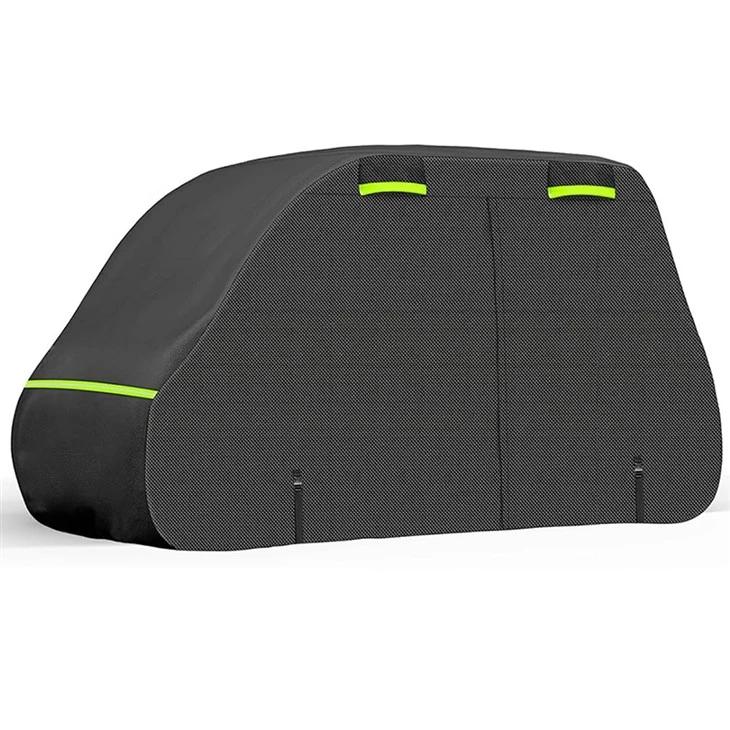

This durable outdoor golf cart cover protects your vehicle from rain, UV rays, dust, and various other outdoor contaminants. It features weather-resistant fabric, a convenient side opening, a built-in ventilation system, and a practical windproof securing system. Designed for long-lasting protection, this cover shields your golf cart when parked outdoors, preventing direct exposure to elements like dust and rain, thereby reducing the need for frequent cleaning and maintenance.
Products Description
1. Fabric
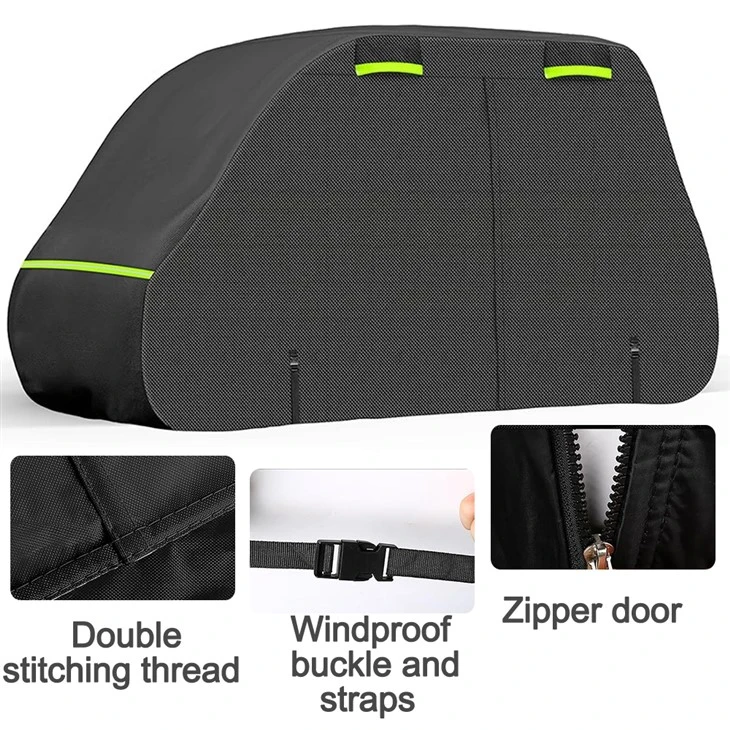
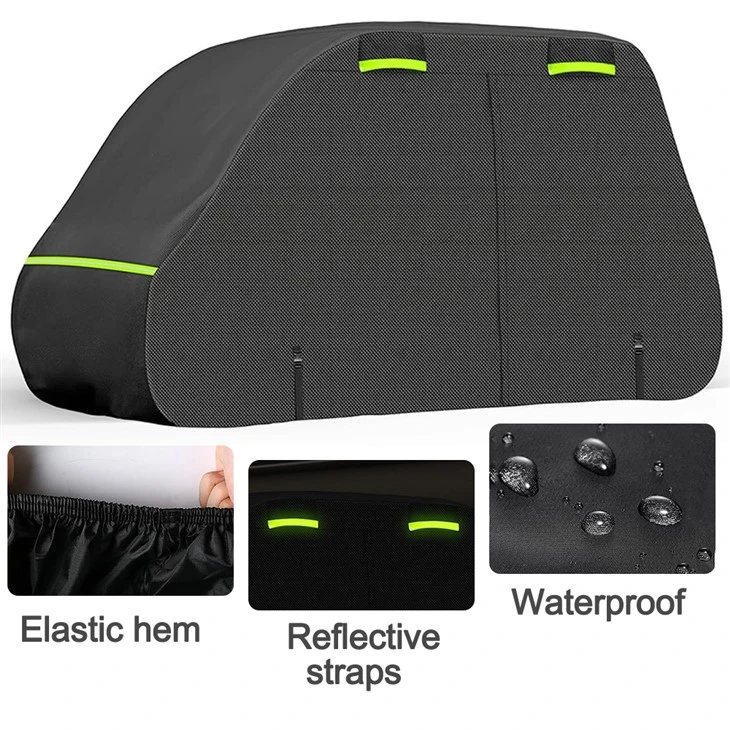
This all-weather outdoor golf cart cover is crafted from 420D polyester with a PU coating, striking an ideal balance between material strength and outdoor protection. It effectively shields against rain, UV rays, dust, and various outdoor pollutants. Furthermore, the cover features double-stitched seams, with reinforced edges and stress points, significantly enhancing its overall durability for outdoor use.
2. Convenience
2.This durable golf cart cover features a zippered side door, allowing users to access the interior-whether to retrieve items or quickly check inside-without needing to remove the entire cover. Additionally, we provide a storage bag made from the same material as the cover itself, making it easy to pack away and store. This keeps the cover clean while not in use, ensuring it is ready for immediate use the next time you need it.
3. Ventilation Design
For golf carts parked outdoors, it is important that the cover features ventilation. Outdoor temperature fluctuations and humid conditions can easily lead to condensation forming inside the cover. This outdoor golf cart cover is designed with four vents, which promote air circulation while the cover is in place, helping to reduce the risk of trapped moisture. It should be noted, however, that ventilation cannot entirely prevent condensation in all environments. Before applying the cover, ensure the vehicle is as dry as possible; in humid or rainy conditions, you should periodically check the covered vehicle.
4. Wind Resistance
This outdoor golf cart cover features full-length wind straps at both the front and rear, ensuring it remains securely anchored to the cart. The bottom of the cover is designed with an elastic hem, allowing for a quick, snug fit while providing additional wind protection. Furthermore, the zippered door includes a Velcro closure at the base, which further enhances its wind-resistant properties. These features ensure the cover stays firmly in place-even in high winds-offering reliable, continuous protection for your golf cart.
5. Reflective Strip Design
This outdoor golf cart cover features reflective strips positioned at the four air vents. These enhance visibility at night, helping to prevent collisions with pedestrians or vehicles when the golf cart is parked outdoors, thereby increasing safety during nighttime outdoor storage.
About Our Company
1. OEM and ODM Product Development
We provide OEM and ODM services tailored to your defined project scope and manufacturing requirements.
OEM Manufacturing: Production based on designs, technical specifications, branding, and packaging requirements confirmed by the client.
ODM Development: Assisting clients in developing products-starting from initial concepts, reference samples, photographs, or functional requirements.
For example, a private-label brand might wish to develop a protective cover for a four-seater electric vehicle, specifying particular fabrics, custom labels, zipper placement, and retail packaging. Such a project is executed through a structured process, including design confirmation, sample development, specification approval, and production planning.
Why this capability is essential: In a highly competitive market, overseas buyers often need to differentiate their products. Custom product development helps them build a cohesive brand identity, precisely target specific customer segments, and establish standardized product specifications-ensuring that future orders can be consistently and accurately replicated.
2. Fabric Selection and Material Customization
The choice of materials directly influences a product's weather resistance, durability, flexibility, ease of use, aesthetic quality, and overall cost.
We work closely with our clients to evaluate and select the most suitable fabrics based on their intended applications and specific requirements. Depending on the project, key considerations may include fabric denier (density), coating type, water resistance, UV resistance, surface texture, and the anticipated storage environment.
For instance, a distributor supplying vehicle covers intended for year-round outdoor use will likely prioritize weather resistance and durability. Conversely, a retailer catering to "occasional-use" customers might place greater emphasis on affordability, ease of use, and compact portability for storage.
Why this capability is crucial: Different markets involve varying price points and usage environments. Selecting the right materials for the intended purpose helps buyers strike an optimal balance between product performance, target pricing, and end-user expectations.
3. Pattern Development and Fit Optimization
When manufacturing golf cart covers, fit is one of the most critical considerations. A cover that is too loose may flap excessively in the wind, while one that is too tight is not only difficult to install but can also place undue stress on seams and openings.
During the development process, we utilize vehicle specifications, reference samples, photographs, technical drawings, and verified measurements to create precise patterns.
Our evaluation process comprehensively accounts for the roof profile, windshield, vehicle perimeter, rear seating area, and the positioning of all access points.
Benefits for Overseas Buyers:
Helps reduce customer complaints related to fit issues.
Ensures consistent coverage across different production batches.
Simplifies the communication of product specifications to distributors and end-users.
Facilitates the identification and resolution of design issues prior to mass production.
In cases where vehicle configurations or intended use scenarios are uncertain, sample evaluation is essential to confirm the fit of the product.
4. Quality Control Throughout the Entire Production Process
Ensuring consistent product quality requires more than just inspecting the finished goods. Every stage-from material selection, cutting precision, sewing techniques, and zipper installation to ventilation design and final packaging-influences the quality of the end product.
Our quality control programs can be tailored to meet the specific specifications and project requirements agreed upon with the client.
Typical inspection stages include:
Incoming Material Inspection: Verifying fabric type, color, coating requirements, and all other agreed-upon material specifications.
Cutting and Pattern Precision: Checking dimensions at critical points to ensure consistency across all components.
Sewing Quality: Inspecting the uniformity of seams, the condition of the stitching, and the reinforcement of specific areas.
Functional Components: Testing the smooth operation of zippers, the integrity of ventilation designs, and other specified functional features.
Finished Product Inspection: Evaluating the overall appearance, dimensions (including fit), workmanship, and the inclusion of all accessories.
Packaging Inspection: Verifying labels, product markings, quantities, and packaging specifications.
For example, checking zipper functionality prior to packaging allows for the identification and resolution of potential issues before the products reach the distributor's warehouse.
The Importance of This Capability: In international trade, returns and exchanges are often costly and time-consuming. A robust inspection process helps minimize avoidable defects, improves consistency between production batches, and makes procurement decisions more predictable.
Inspection methods, acceptance criteria, and testing requirements should be agreed upon with the client prior to the start of production.
5. Flexible Order Planning and Ongoing Production
Different clients have distinct procurement needs. Product development projects typically begin with sampling, progress to trial orders, and eventually evolve into sustained, large-scale production.
We evaluate each project based on specific order requirements, considering factors such as order volume, material availability, customization needs, production scheduling, and packaging specifications.
For instance, an importer entering a new market may need to verify product suitability and market demand before committing to large orders; conversely, a distributor with established sales channels might prioritize consistent, ongoing production based on fixed specifications.
The value of this capability: Flexible order planning enables overseas buyers to manage inventory risks, test new product categories, and align their procurement plans with sales forecasts.
For every project, we negotiate Minimum Order Quantities (MOQs), lead times, and production capacity based on the client's specific requirements, rather than applying a one-size-fits-all standard to all products.
6.Export-oriented communication and order coordination
International manufacturing involves much more than producing physical products. Buyers also need clear product specifications, reliable communication mechanisms, packaging coordination, and various documents that meet shipping requirements.
We can coordinate and implement various planned project information, including:
Product specifications and sample confirmation.
Customized details and defined production requirements.
Packaging and labeling instructions.
Order progress and production plan updates.
Commercial documents and shipping documents within the agreed scope.
Specification requirements and product revisions for subsequent orders.
For example, if a buyer needs to adjust the position of a zipper after reviewing a sample, documenting this change can effectively reduce the risk of the product not meeting requirements due to production to old specifications.
The importance of this ability: Clear communication can reduce misunderstandings caused by cross-time zones and help importers effectively connect production links with warehousing, distribution and sales plans.
Each order's shipping arrangements, estimated delivery time, payment terms, and required export documents are subject to confirmation.
FAQ
Q: Why do golf cart covers feature a side-door zipper?
A: The side-door zipper allows users to access the vehicle through a designated opening without having to remove the entire cover. This makes daily entry and exit much more convenient for those who frequently park and use their golf cart.
Q: What is the purpose of the four air vents?
A: These four vents are designed to promote air circulation beneath the cover, which helps reduce moisture buildup under the right conditions. However, this ventilation design cannot entirely prevent condensation-especially in environments that remain damp or rainy for extended periods-so it is advisable to periodically check the interior of the golf cart and the condition of the cover.
Q: Can the dimensions be customized for different golf cart models?
A: Yes. We offer custom development based on specific vehicle models, design requirements, and order specifications. Clients may provide vehicle details, photographs, technical drawings, dimensional data, or reference samples to help determine the required specifications. The final fit will be verified through a sample-based approval process agreed upon by both parties.
Q: Do you offer OEM or private-label customization for car covers?
A: For OEM or private-label projects, we can evaluate options regarding material selection, colors, labeling, packaging, and functional design details. If a project requires entirely new patterns or product configurations, we also provide development services. The available options will depend on the defined project scope and production requirements.
Q: What information should I provide when requesting a quote?
A: To help us evaluate your project more efficiently, please provide the following information: the make and model of the target vehicle, reference photos or drawings, estimated order quantity, preferred fabrics or performance specifications, branding/logo requirements, and packaging specifications. If the vehicle configuration is non-standard, additional dimensional data or physical samples may be required; please contact us to confirm the specific details.
Q: Can samples be provided before mass production?
A: We can discuss sample development based on your project requirements. Through sample evaluation, buyers can assess the product's materials, craftsmanship, design details, and suitability before confirming a bulk order. Specific arrangements-including sample availability, costs, and lead times-will be determined on a project-by-project basis.
Inquiry for Custom Golf Cart Covers
Are you looking for a reliable manufacturing partner for golf cart covers?
Whether you are an importer, wholesaler, distributor, aftermarket retailer, or a brand owner, we are here to help you assess your requirements for custom golf cart covers.
From developing patterns for specific vehicle models and selecting materials to providing OEM/ODM customization, quality control planning, and coordinating packaging solutions, our goal is to assist you in creating products that perfectly align with the needs of your target market.
Please reach out to us to discuss your project requirements. Kindly provide details such as the target vehicle models, reference photos or drawings, estimated order quantities, preferred materials, branding/logo requirements, and your target market. Our team will evaluate your specific needs and work with you to develop an appropriate production strategy.
Let's collaborate to create a golf cart cover solution tailored specifically to your products, your customers, and your business requirements.
Hot Tags: all weather golf cart cover with side door, Chain all weather golf cart cover with side door manufacturers, suppliers, factory